Wednesday, July 09, 2008

THE SIMPLE STEPS YOU MUST TAKE TO GET YOUR ARTICLES PUBLISHED

This month’s article is a long one, but it holds information that is important to anyone who wants to have articles published in magazines. Most writers think they must have experience or know someone in the magazine industry to get their first article published, but that’s not necessarily true. All new writers get their start somewhere, and often it’s a paying assignment in a magazine.

My first opportunity at getting published was a thrill, but it wouldn’t have happened if I hadn’t worked up the nerve to approach a magazine editor at an interior design lecture in Seattle. My only previous publishing experience consisted of 3 or 4 very short articles on decorating in a small beach town newspaper for no pay. The newspaper had also published my photo and byline with the articles. I used copies of them to show that I had been published, and editors that I was approaching could see at a glance that I had experience, no matter how pathetic it was.

Those few short articles got me an audience with the editor of a leading interior design magazine, and I was given an assignment to produce an article. I wrote the article, for which the magazine was a great showcase. The magazine did not pay (I was so excited I had forgotten to ask about that), but that one assignment led to others, plus it gave me the confidence to pursue even more magazine assignments.

I found that the best avenue to getting published is to learn how to approach an editor, then do it confidently. I have learned that confidence counts as much as experience, and sometimes new writers must “fake” their confidence as they begin to dip their toes into the publishing industry. Write query letters with the self-assurance of a professional. Start the letter with a fabulous quote from your article so you’ll get the editor’s attention from the get-go.


I recommend that you buy a book on writing query letters, read it thoroughly, and build on the examples there. You’ll learn a lot about what editors want to see, so these books should be on your personal bookshelf on writing. Hopefully, you also have a copy of my book, Portable Writing, which details 25 different projects that I have created over the years to earn income, including published articles and books. And you should also learn how to format a manuscript, which I describe at the end of this article.

If you are approaching a magazine editor who does not want to see a query letter, but instead, wants to see the completed article, then decide whether the magazine pays enough and whether your chances are good enough to make it worthwhile. It’s a bigger job to write a complete article, but truly, sometimes it’s more difficult to produce a really great query letter. The editor of Escapees Magazine, Janice Lasko, does not want query letters because she’s found that articles often don’t live up to the promises or quality of the query letter. Escapees Magazine is an excellent market for your articles on all phases of RVing. Read the magazine to see what types of articles get published.

Getting published means you MUST take several steps first:

  1. Know your audience. Read the magazine you want to write for. Read it thoroughly, including the ads and letters-to-the-editor column. You need to find out what types of articles the magazine wants, whether the articles include personal experiences or not, and you want to determine who its readers are. Are the readers and subscribers young parents or retirees? Are they middle class or upper income? What are their interests and hobbies? Are they male or female, or both? Do they like to travel, or do their lives focus on family and home? Often the best clue to who reads the magazine is determined by simply perusing the ads. Advertisers don’t pay big bucks to scatter their message to readers who aren’t interested in their product.
  2. Request the “Writers Guidelines” from each magazine for which you wish to write. Sometimes you can go online and download a copy of the guidelines, but if you mail away for them, include a self-addressed, stamped envelope with a note stating “request for writers guidelines.”
  3. Submit what the editor wants. If a query letter is requested, then learn how to write the best one that you can. If the completed article is wanted, then make sure you write the most thorough article you can within the number of words requested.
  4. Make sure you adhere to the editor’s word count. If your article turns out to be 2000 words and the guidelines specifies 1500 words, do not send 2000 words hoping the editor will be so excited by your writing that it will be accepted. It won’t! Start cutting. I can promise you that any article can be made better by tightening the writing. There are always extra words, especially connecting words that can be cut. There will be sentences that don’t really add content to the article, so cut them. There may be a way to rearrange paragraphs or sentences to shorten them. Remember that any article, no matter how wonderful, can be made greater by judicious cutting.
  5. Make sure the information in your article is accurate. If you write something but aren’t really sure if the place name is correct, or spelled correctly, get online and research it. Make a mistake, and that editor won’t ever read your letters or articles again.
  6. Keep a Thesaurus handy. When I worked for a publisher, the first thing I was handed was a Thesaurus because I had to know a 1000 ways to say the word “precious.” I gagged as I sought out other ways to say it, but that was one of the most popular expressions used in that particular magazine. You do not want to keep repeating a word, any word, throughout your article.
  7. Write in the active voice. Avoid passive words when possible. Active words draw readers in and hold their interest, plus your articles can often be shortened by changing sentences to the active voice. Example: “John became upset when it was suggested that he should sell his big SUV if he could no longer afford the gas for it.” “John was livid at the suggestion that he sell his big SUV to save money on gas.” Notice that the passive voice uses 24 words to say the same thing as the 17-word active voice sentence. Besides making your writing more interesting, sentences will probably be shorter and more to the point in the active voice.
  8. Remember that any holiday or seasonal article should be submitted at least 6-9 months before the publication date.
  9. When finished, put your manuscript away for a couple of days, then read it aloud. And ask someone else to read it.
  10. Use the spell check and grammar check to find any problem areas. Remember that a spell check cannot discern between a typo that creates the wrong word, such as when the word hare or hard should really be harp. Also it won’t know whether you meant to write are or or. And also realize that the grammar check sometimes makes outrageous suggestions, so if a problem crops up, don’t take their word for it. Read your sentence to see if it might be awkwardly worded, then rewrite it to suit your meaning.

Important: Before you put your article in the envelope, be sure to give it one final, careful reading to make sure it is perfect. And remember to include photos, if they are being sent with the article, and a self-addressed, stamped envelope. Of course, if you are sending you manuscript by email, there’s no need for a SASE and photos would be sent according to the editor’s wishes.

To find magazines to write for that you may not be familiar with, buy a copy of Writer’s Market or go to your public library to find the current copy, plus read back issues of Writer’s Digest and The Writer Magazines. All three provide many useful articles on writing for publication and provide a listing of magazine and book publishers.

Formatting a manuscript

Manuscripts most typically have 1-1/2 inch margins on sides and at top and bottom, and should be double-spaced. In the top left-hand corner, type your name; 2nd and 3rd lines: address; 4th line: telephone number; and 5th line: email address.

In the top right-hand corner, type which rights you are selling. Typically, this would read “First North American Rights” but could be “Second Rights” if the article has previously been published elsewhere. Beneath that on the 2nd line, list how many words are used. On the 3rd line you can put “Copyright (or ©) by your name.” There is some argument about whether you should add this line because some editors take offense, but I always include it so that the editor will know that I’m not selling all rights to the article. If you are including photos, on the 4th line type Photos: 10, or the number that you are including.

Drop down about 1/3 to 1/2 of the page and type in the title, centered and in bold type. Drop down two more spaces and type “By your name.” Skip two lines before starting the article. Indent the first line of each paragraph about 5 spaces.

At the bottom of each page, type continued, if the article is continued on the next page. At the top of each following page, type your last name at the top right and the page number at the top left of the page. This is important in case the editor drops your article and has to reassemble it.

Make sure your manuscript is double-spaced. At the end of the article, center and type - end - or ###.

Make sure that you address your letter to the correct editor, and that you spell the editor’s name correctly. Writer’s Market entries usually include lots of information, including the editor’s name and rate of pay. Again, send for the magazine’s “writers guidelines” before actually sending off an article and it pays to check with the publisher to double-check the editor’s name.

That’s all there is to it. You’ll quickly become familiar with all the steps as you submit more and more manuscripts for publication. And you’ll occasionally find exceptions to some of the steps I’ve listed above. No matter what topics you write about, you’ll find that the more you write, the easier the entire process will become.

$7000 in Prizes in First Person Story Contest

The Narrative First-person Story Contest with $7000 in prizes starts May 1, 2008 for entries of fiction and non-fiction. Deadline is July 31, 2008. (I have no personal experience with this Website, but this might be a wonderful opportunity to get your story published and win some money.) For more information, go to
www.narrativemagazine.com.
FUN AND KNOWLEDGE AT ESCAPADE IN GILLETTE, WYOMING

This has been a busy couple of weeks. Last week we attended the 30th anniversary of the Escapees RV Club (
www.escapees.com). They hold an Escapade once or twice every year, but this was the first one we had ever attended. More than 1000 RVs were parked in RV Parks at the Camplex in Gillette, Wyoming with more than 2000 people attending the various workshops, lectures, and other festivities.

The Escapees’ writers group, Penwheels, also had a meeting there, so it was the first time I met the other members. The editor of Escapees Magazine attended as well as many others whose names appear regularly there as authors of articles on a variety of topics. It was especially exciting to meet three of the writers who had generously shared their stories of the Boomer era in my book, Looking Back. Dave Beckes, who is also a subscriber to this newsletter and wrote Segregation and a Vietnam Vet for the book, and Barbara Bowers, who wrote Lessons Learned from 9/11, both attended the Penwheels meeting. Later I met Everett Bowers, whose essay, Through the Lens of a Boomer, also appeared in the book.

The market area had many vendors offering products for RVers that we hadn’t yet seen, so we’re the proud of owners of several of those items, including a couple that I won in one of the many door prize drawings.

Right now we’re in Cheyenne, Wyoming visiting friends and doing some sightseeing before heading back to Arizona. Unfortunately, we must skip the rest of our planned trip to Texas and Arkansas to attend to some medical needs, but we hope to head out again later in the year to finish our trip.

Happy trails to all you RVers, and safe travels to every one of you.

Tuesday, June 24, 2008

IS FREELANCE WRITING ILLEGAL IN SOME RV PARKS?

One of the most common rules in RV Parks is that no business activity is allowed. That could technically include writers, investors, artists, web designers, business consultants, or any other activity that makes money. If taken literally, this particular rule could exclude a lot of people from staying in most RV parks across the country.

So what do you do if you are a writer or consultant who uses your computer to earn a living while you travell?

After much discussion with various park owners I've discovered that these rules were made to prevent any activity that would be obvious to other guests. They don't want businesses that would:

1) Create or increase traffic.

This would include retail businesses operated from an RV or someone providing a service that requires customers to come into the RV Park. Writing and consulting don't normally cause such problems.

2) Cause a risk to the owners' reputation.

Anything illegal could risk the reputation of owners, but if a guest is not doing anything illegal, immoral, or creating excessive noise or pollution, RVers should have no problem. Obviously, operating an illegal Website could become a problem if it attracted the attention of authorities.

3) Cause a nuisance to other guests or create a hazard or risk for the park:

Obviously, making money as a mechanic who works on cars or RVs, giving haircuts and shampoos, or grooming animals, or any number of other activities could be a nuisance to other guests if they increase traffic or take place outside the RV. And some of these activities could run afoul of local officials if proper permits weren't obtained. However, businesses that use computers inside the RV, or where the guest leaves the Park to call on clients should in no way compromise the owners.

4) Use excessive utilities.

First of all, if you are on extended stay and paying for electricity along with your site rent, using your computer extensively should not be a problem. And those using their computers for business may not actually spend as many hours on them as non-working guests emailing their friends and surfing the Internet. Overnighters use the park's electricity, but since those visitors aren't on site for a long period it's doubtful that much extra electricty would be used.

So if you are a working writer or consultant you should have no fear of breaking this particular rule, or of angering management because of your business activities. If you obey the other rules and don't call attention to your business, you should not have to defend your activities.

Some places we stay know that I'm a writer while others don't. Writing has no more impact on the RV Park than guests using their computers for emails and to surf the Internet, so there is little to be concerned about. The only reason I could think that management might kick someone out of a park for violating that rule would be that they use it as an excuse to get rid of someone they want to exclude for some other reason, which could be anything from discrimination based on race and nationality, or simply not liking the condition of their RV.

So do freelance writers need to fear being refused a site in an RV Park? The answer is no as long as you don't call unnecessary attention to yourself or your rig. Write to your heart's content and enjoy a thousand different views outside your window as you roam the continent. We RVing writers are a very lucky group of individuals.

Saturday, June 14, 2008

IF YOU'RE PLANNING TO VISIT SPOKANE, YOU MIGHT WANT TO AVOID THIS RV PARK

Writers who are also RVers should expect to stay in RV parks that offer large enough sites for minimal quiet and an uninterrupted source of electricity so that you can work in your RV. It's a rare event when I complain about an RV park, but we have just had one of the worst experiences in our sixteen years of RVing. Most RV parks at the minimum, provide an adequate campsite, and if a problem comes up that will inconvenience the RVer, the park owners will either offer to move the RVer or refund their money.

We've just discovered one where management doesn't give a flip whether your site is adequate or not once they have your money (non-refundable), so I decided I should start rating some RV parks that we stay in if they are really bad or really good. The average ones don't need to be mentioned here.

One of the worst we've found is Trailer Inns located in Spokane, Washington. It's the only one within the metropolitan area so that's why we chose it, but in the future we will drive over to Idaho (15 miles away) to stay when we want to visit relatives in Spokane Valley. This one was 7 miles from our relatives. On a scale of 1 to 5, Trailer Inns in Spokane rates a big fat goose egg! The only upside is that it is convenient to the city of Spokane if you ever need to go there, but we've never found a good reason to go downtown.

Next time I'll write about some of the parks that offer much more than expected. Outstanding facilities and service deserve mention as surely as the miserable places do and we've stayed in some beautiful spots.

Trailer Inns rating: 0

Sunday, June 01, 2008

Another Money-making Writing Project

Some of the writing projects in my book, Portable Writing, require that writers sell advertising to finance their project, but let’s face it, we all have to sell ourselves throughout our lives. Change jobs—sell your skills to a new boss. Try to get someone to see your point of view on a topic—sell your idea. So selling ads isn’t any harder than selling your point of view except that you might have to approach a stranger? And you’ll be pleasantly surprised at how happy a lot of business people are to support a local entrepreneur/writer.

One of the easiest projects I’ve done is a little trivia newsletter that you can write, sell advertisements for, then distribute to local restaurants or other places of businesses where people spend time sitting and waiting for service. I know you’ve probably seen these small flyers in restaurants—most often in local family-style eateries.

To get started, think of some interesting trivia and history about your local area. People traveling through as well as locals will love reading about the history of the area as well as about colorful characters from the past, jokes and short, funny stories. Don’t make the articles long. Funny stories and jokes (non-copyrighted) can be used as fillers. Your written material need not fill more than about 30 percent of the total space, and can even be as small as 20 percent. By dividing your pages into columns, then planning which space will be used as ads and which for editorial space, you can come up with the total number of ads you will need to sell.

Layout a small newsletter (2 pages of 8-1/2 x 13” folded in half will work). This size will be small enough that it won’t take up too much space on a dining table. Be sure to leave space for ads—business card size ads will probably sell best. Once you have a dummy made up with your ad spaces shown as blank rectangles, then approach some local restaurants about distributing them. Find out approximately how many copies each eatery will need, add them up, and that will be your total printing number. The higher your distribution number, the more advertisers you can attract.

Once you have your distribution number, get prices on printing the newsletter. Remember, your newsletter doesn’t have to look special and it doesn’t have to use color or photos. Plain black ink on white or colored paper will work fine. Once you’ve figured out how much printing and distribution will cost, you’re ready to come up with ad costs and start selling ads.

Count the number of ads you’ve left space for, then divide them into the total printing and distribution costs. Add your profit before coming up with total costs per advertiser, then start marketing the ads. You might plan prices for a couple of half-page or quarter-page ads in case a business wants to buy that size—which may mean that you have to juggle some space when you layout the final project. Some business owners want large ads.

You’ll want to plan for replacement costs if restaurants run out before your next issue. Plan quarterly, twice-yearly or yearly issues, although the more often you print up new ones and sell ads, the more timely your product will be. Readers can get put off if they see an ad for a local business, then find out it has gone out of business.

This is a project that you control from the beginning. It’s your original work which is supported by ads you sell, and you have final say about how it looks. It’s a win-win-win situation for the advertisers, for consumers who welcome reading the newsletters, and for you, the writer.
Another “Top Gear” RVing catastrophe

The BBC-America show, Top Gear recently featured a “caravaning” (RVing) trip in a light-weight trailer pulled by an undersized vehicle. For hilarity, the three hosts on this television show can’t be topped.

This time, Jeremy, James and Richard, along with their Top Gear dog pulled the trailer to a caravan park (similar to our American RV parks) in the English countryside. James managed to back the trailer over a tent in the next site, and then he and Jeremy tried to straighten the supports up since the owners weren’t around. Next morning Jeremy set their trailer on fire while cooking breakfast, burning it, plus the tent next door that they had previously knocked down, to a crisp. Watch their latest catastrophe at:
http://www.youtube.com/watch?v=0GZRmzuiig8&feature=related.

If you haven’t caught this show on TV, you really should check out the fun provided by the hosts’ unending automotive-related competitions and misadventures.

Meanwhile, our next misadventure may be getting kicked out of an RV park late one night for laughing too loud and keeping the neighbors awake while watching the riotous antics on Top Gear. The show appears on Monday nights on DirecTV, but may be on at a different time on Dish TV or your cable company. And you can still watch the hilarious motorhome race that took place on the show by clicking on this link:
http://www.youtube.com/watch?v=gourYCpaJLU&eurl=http://rvvideos.blogspot.com/2008_04_01_archive.html.
Another RVing Misadventure!

Our next stupid RV trick happened when we were in West Virginia and hubby needed a part for our brand new, larger RV. Everything in town was on a hillside, so his only choice was to turn into a downhill or uphill lot. So he found an auto parts store with a large parking lot on the downhill side of the road. There was another drive where he could exit back out onto the road, so no problem. Ha!

We were towing the car, so when he finished shopping and started out the drive to the road, the hitch became embedded into the blacktop and wouldn’t budge. It looked as though we were permanently, deeply rooted in the exit drive. We managed to get the car unhitched and I moved it away from the RV, then called the emergency road service once again! They finally arrived and hoisted up the back end of the motorhome to free it from the blacktop and get it moving. Somehow we once again got back on the road with everything but our dignity intact.

Then there was the time in Kentucky when we wanted to visit a park just outside a small town. We made it to the park and had an enjoyable lunch in a quiet, peaceful setting beside a bubbling creek, then when we left, hubby decided to save some miles by going through the nearby town and joining back up with the freeway. The town was a nice little place and we made it fine until we were almost back to the freeway. Looming ahead was one of those bridges with a metal sub-structure, and no clue about how high the clearance was. We knew our new motorhome with the air conditioner and other vents was tall, so we stopped and pondered what to do.

Then we thought of the 25-foot metal tape measure we had with us, and hubby climbed out to go measure the clearance, leaving the motorhome parked by the road. Only thing, the wind was howling and he couldn’t get the tape measure to stay put while he inched it up the skeleton of the bridge. Finally, we decided I would have to block traffic while he attempted to turn the motorhome around and head back through town. Did I mention that we had just topped a hill and were headed downhill when we spotted the bridge ahead?

Well, I managed to stop what little traffic was traveling the road, and somehow he got 34 feet of motorhome with a car in tow turned around on a two-lane highway. Yet another misadventure under out belts.

I will have to say that we learned from those first few mistakes. Traveling has been a lot more pleasant (and safer) since 1995. Oops, I forgot about the metal pipe sticking up out of the asphalt in a parking lot that hubby managed to not see and sideswipe, scraping up all of the storage compartment doors on one side. Or the time he was directing me back to get propane but forgot to notice the overhang that I couldn’t see in the rearview side mirrors before I bumped it, bending our ladder.

Looking back, I believe we’ve had more misadventures that most RVers, but seriously, none that we can’t look back on and laugh about today. Okay, so we’ve developed a perverse sense of humor. And amazingly, we’re still together.
I am sending part of an article by Angela Hoy, below, so that readers who plan to self-publish or use a Print on Demand Publisher can be aware of Amazon.com’s demand that all POD books that it sells be printed by BookSurge, which is owned by Amazon. This appears as though it might violate anti-trust laws and could lead to Amazon not selling any books from any publisher that doesn’t use their printer, and could drive up book prices. So it is important to readers, self-publishers, and POD publishers alike.

BookLocker Files Class Action Lawsuit Against Amazon.com
By Angela Hoy


This article appeared in Monday's Special Edition of WritersWeekly.com. You may reprint this article or quote from it at your discretion. You can read/post comments here:
http://antitrust.booklocker.com

BookLocker.com has filed a class action lawsuit against Amazon.com in response to Amazon's recent attempts to force all publishers using Print on Demand (POD) technology to pay Amazon to print their books.

STRONG DISSENT FROM INDUSTRY REPRESENTATIVES


The Author's Guild, the American Society of Journalists and Authors (ASJA), The Small Publishers Association of North America (SPAN), YouWriteOn.com (the U.K.'s leading writer's website) and the National Writer's Union have all issued strong statements denouncing Amazon's attempted power grab of the industry.

We cannot say for certain if what Amazon is doing is legal or not at this point; that is for the Federal courts to decide. However, in our opinion, the seemingly covert manner in which Amazon has conducted itself in this matter seems to make their actions highly suspicious.

WHAT'S NEXT?

Amazon has already taken control of publishers' ebook sales on the Amazon.com website by requiring ebooks be available for their ebook reader, the Kindle. Now, Amazon is attempting to take control of the printing of all POD books. We wonder if traditionally published books are next. Some are speculating that Amazon won't stop until they are being paid to print every book they sell.

ARE YOU AFFECTED?

According to Amazon's public statement, ALL POD books will be affected. If you are a POD publisher (this includes self-published authors who publish their own POD books through a printer), and would like more information, please contact:
Angela Hoy, Publisher

BookLocker.com
angela - at - booklocker.com
Scary to Make the Leap to Writing, But Oh So Rewarding

Sometimes, all one needs to make a leap of faith is a little nudge. I hope reading this post will give you the push you need to get started. I want to talk this time about how writing can be the salvation of those who move often because of job transfers, and for those who want to travel and see the country, or the world. And for that matter, retirees looking for fulfilling, money-making hobby.


My husband was in the military when we married, so for years I was shuffled from place to place, and each time we moved I had to find a new job. I even went back to school and studied interior design, which in addition to writing, had been my dream since childhood. I acquired a skill that was fairly portable. Stressful but portable. And every time we moved somewhere new, it meant starting all over again.

So what could I have done differently, had I been more aware of the opportunities available? I would have started my writing career much earlier than I did! I worked as a secretary for several years, and each place I worked, I was given additional duties after my bosses discovered I had writing skills—jobs such as composing letters and creating newsletters. So in effect, I gave my services away.

Still, I can’t complain because I learned a lot during those years—like how to manage a business, provide excellent customer service, work with difficult people, and the types of communication materials needed by for-profit and non-profit entities. I did clerical work in a department store, a University Medical Center and School, County and State offices, and a huge church, plus I gained valuable knowledge about the operations of retail businesses where I worked as a designer, which gave me diverse experiences to carry forward. None of the jobs would have indicated to anyone else that I had what it took to succeed as a freelance writer, but in my heart, I knew I could do it. And that’s all it takes, really.

They say success happens when opportunity meets preparation (or something to that effect), so when I finally made the decision to become a full-time, committed freelance writer, I was ready. And maybe that’s the way it was meant to be. Maybe I needed maturity as well as life experience. You probably have those things already.

Now I can travel wherever I wish and write wherever I happen to be. This isn’t a fairytale life, but it is the life I’ve chosen for myself, and it is good. I am living my dream!

For those of you still toiling away working for someone else or dreaming of writing for a living, I urge you learn from the projects featured in Portable Writing, some of which are outlined in this newsletter, and then apply your new-found knowledge to starting your own writing career.

I know that it is scary to take a leap of faith into the unknown, but the longer you wait, the more time you lose. You can do what I have done, and probably much, much better. Don’t let time pass by until someday, all you may be left with is regret that you never even tried.

Tuesday, May 27, 2008

Go RVing

I’m sure you’ve seen ads for Go RVing in magazines, but did you know that they offer a free CD or DVD on RVing. If you are interested, check their Website at
www.GoRVing.com or phone 1-888-GoRVing to find out more and receive a free copy.
Warning about Wi-Fi

This seems like a good time to warn RVers and others that use Wi-Fi Internet connections that your communications over a Wi-Fi network might not be as private as you wish. A Wi-Fi transmission could be captured by a clever hacker, so you definitely do not want to transact personal business or banking activities over it. Never reveal any personal information when using a Wi-Fi connection.

As you travel, always check to make sure you are connected to YOUR Internet provider when conducting personal business, since your computer might automatically connect to the nearest signal—which could be Wi-Fi or a neighbor’s other non-secure connection. Wi-Fi connections are great for emails and non-private communications, but Wi-Fi hotspots like those offered by coffee shops, truck stops, hotels, and RV parks are not secure.

Friday, May 02, 2008

Recession and Inflation: Should I Worry?
There’s Never Been a Better Time to Succeed as a Writer


Once again the country seems to be in the midst of a recession, or as the government prefers to call it, a little downturn, and we’re witnessing record inflation. To many, this is the worst of times.

However, for those who write, this can be the best of times. Why? Well for starters, businesses are also hurting. After investing time and money getting their business reputations established, some will have to decide between laying off employees and barely hanging on, or closing the doors permanently. Not only that, but many of the newly unemployed will start their own businesses—many of them home-based.

How can you profit? First of all, business owners need news releases. Anytime a new business opens, or new staff is added, or there’s any other newsworthy change, a news release should be mailed to local and regional newspapers. Among other products you can offer are newsletters, marketing letters, advertorials (advertising/editorial columns), ghostwritten articles, and even Web site content. If you have a desktop publishing program, you can expand your range of products.

So how can you get started in this lucrative field? First of all, pick up some “how to” books on business and copywriting. My book, Portable Writing provides detailed instructions for 25 projects that I’ve provided to businesses, some of which have never before been shared in a freelance writing book, but I also recommend any book by Bob Bly on copywriting and freelance writing. Then get a business card printed for your new writing business. It should include your name, phone number and email address where you can be reached, and it should tell what you do. You can make it multi-purpose by listing “freelance writer,” but the card should also say something like “business writing consultant.” Then tell prospects that you help business owners get publicity and attract new customers.

Offer to help a friend in business with publicity or marketing for their service or product. Next, attend meetings of business organizations in your local area to meet more business owners. Use any samples you’ve acquired, and if you have any published clips, put them all in protective plastic covers and show them as proof that you are a professional. However, even if you don’t have any published examples, sit down at your computer and write an article on your business and the services you offer to other businesses, then lay it out in a two-column format with a headline. Scan in a photo of yourself, and print out a copy.


When you’re really comfortable with what you’ve written, print out several copies and hand them out at meetings as a marketing tool. You also need to write a news release for your own business to send to your local AND regional papers, so add a copy of that in your portfolio—published or not. Prospects want to see that you can write and most won’t really care if you’ve been published or not.

My clients ranged from the home-based sole-proprietor to corporations, but it all started with one business owner. Business grew brick by brick, client by client, until I had more work than I could handle alone. When it reached that point—I began to pick and choose which types of projects I preferred to focus on—and at that moment, I realized that I had built my dream business. Then I took it on the road. And this all happened during a recession when many bigger businesses were failing.


My theory is that successful people look for creative opportunities in troubled times. Meanwhile, writers have the ability to help business owners in times of trouble by providing business-growing, profit-producing services. It's the perfect win/win situation.

Wednesday, April 30, 2008

Why your book should be offered as an e-book

A lot of people ask me, why would anyone buy an e-book (or ebook)? Of course, most of those who ask have plenty of storage space for books. Or, they simply like the idea of holding a book in their hands and flipping through the pages. For those of you unfamiliar with the term e-book, it simply means an electronic copy of a book.

I’ll admit that I’m fond of old-fashioned reading, but as an RVer who likes to have plenty of reading material with me when I travel, I can’t carry that many books. So the ones that I read, then don’t care to read again, I leave at RV parks, usually in the laundry room, for the next reader. I’ve also picked up some of the best books I’ve read there—you know the out-of-print titles that you can’t find at bookstores anymore, and they’ve been removed from library shelves. There were several years during my adult life where I simply didn’t have time to read, and now I’m trying to catch up on some of the good books I missed.

Electronic books are quickly gaining favor as the new way to purchase and read books. Once you find what you like at an online bookstore, you can download it immediately, usually for a lower price than a bound copy, and there’s no wait for the book to arrive in the mail and no shipping fees.


This is perfect for RVers, who can download e-books to the computer and read them on screen, or they can be downloaded onto electronic readers and carried to read while waiting in the doctor’s office or for car repairs, etc. These little readers are still quite expensive, but they usually hold multiple books. And prices will surely come down as more and more buyers seek them out. Think of the space they will save—six books in an electronic gizmo smaller than a paperback.

E-books can also be saved on a CD, which stores in way less space than a book, and you can squeeze several e-books onto each shiny disk.


E-books seem to have found a place in today’s society, but I still enjoying having hard copies of anything I’m going to read over and over because I like to highlight special passages. I suppose I could do the same on a computer copy of a book, but there’s just something about being able to manually flip to a page and read it again.

POD publishers like Booklocker have found, after several years of offering books this way, that more non-fiction books sell as e-books. And I’ve found it’s true for my books. Portable Writing has sold many more copies as e-books than as hard copies. It remains to be seen which way will win the most sales of Looking Back. So far, it has sold more as hard copies, but I suspect that a lot of buyers have been shopping for gifts for their friends and family. One buyer even wrote to tell me she bought 12 copies for Christmas gifts. Fiction books still sell better in hard copy for some reason.

And what's to keep your work from being stolen off the Internet? There’s always the chance that someone will purchase and download a copy of a book, then illegally copy and distribute it themselves. That violates copyright laws, and violators almost always get caught since it is so easy to type in a book title and search the Web, where you’ll discover all the places that your book is offered—legal or not.

For those who are thinking about getting their first book published, e-books can be self-published very easily. Just format yours as a PDF file and offer it for sale on your own Web site or blog. If you want to write a family memoir, this may be the perfect way to distribute it since there are no printing or mailing costs involved. E-books are definitely here to stay.
How to Avoid Procrastination and Stay on Track

I would love to say that I never procrastinate, but that would be absolutely untrue. I can put things off as easily as anyone. But I have found a way to avoid procrastination, and it’s called a schedule. Yes, you read that right. A schedule—in the form of a to-do list. There’s the long-term goal list, and from it I make a daily to-do list.

I sit down the night before and make out the to-do list so I can start right in on it the next morning. I list the major tasks I want to complete the next day, then I assign a time allotment to each task. Say I need to do a particular type of marketing, such as getting on the Internet and locating newspapers to contact with press releases. And I also want to work on an article for a particular publication, or write something for one of my blogs. I put all the things I feel are necessary to get done right away on my to-do list.

Next morning when I wake up, I don’t have to sit down and try to figure out what should be done first. It’s written down in black and white. I find it is so much easier to follow a script for the day than try to figure it out after breakfast, when it might be tempting to just goof off.

I could never have written three books, scores of articles, and worked for businesses without some sort of schedule to keep me on track, so my daily to-do list is an absolute necessity.

Then there are those days when I don’t really want to avoid procrastination. Sometimes it is simply too tempting to ignore the schedule and go play. For instance, the weather is beautiful and I don’t have a looming deadline, so I take the day off and do whatever I want. But when I seriously need to achieve certain goals and meet a deadline, I can look at my to-do list and begin checking off the items, one-by-one, as I finish them.

By the way, you can make up “To-Do” forms on your computer and store them there, or print them out and fill them in each night. I like a printed form that I can hold in my hand, so I can clip completed forms together and save them. Then, at the end of a year, I can look back and see how much has been accomplished. There’s something really rewarding and inspiring about seeing a stack of to-do lists with every item on them checked off.

Succeeding at writing and avoiding procrastination isn’t rocket science. It simply involves deciding what you want to achieve, then scheduling the steps necessary to reach your goals. Or as I was taught many years ago: “plan your work, then work your plan.” It really is that easy.
The "Precious Moments" Crisis

Since we were going to be near Carthage, Missouri and I knew my sister loved Precious Moments figurines, we decided to pay the chapel and home of the precious little dust catchers a visit. They basically make me gag, but for her, I would make the supreme sacrifice! Besides, I needed an appropriate gift for a young friend just graduating from nursing school, and I thought I might find something there.

Well, as hubby started to turn into the parking lot, I pointed out in my nicest voice that the big rigs seemed to be parking across the street. My most pleasant voice wasn’t heard above the testosterone drumming in his loins as he sensed a challenge. So he turned into the vehicle lot. Then I spotted some RVs at the left end of the parking lot and suggested that he go that way. But again, he no can hear wife’s sweet suggestion. So he plowed straight down the middle row of the lot, thinking he could turn at the other end and get to the outer edge of the lot.

He was wrong! We got to the end of the row before he realized it was a dead-end. Not only that, the engine died at just that moment. No amount of cranking could get it started again, so he decided to unhook the car and have me park it while he continued trying to crank the motorhome. He hoped to be able to get it started and back it out of the parking lot, with his darling little spouse directing, of course.

After a couple more futile attempts to start the engine, I finally hiked into the gift shop to find a pay phone to call our emergency road service. As I came out, a security guard came rushing up frantically signaling hubby to get that giant boxcar out of his parking lot. I explained that we couldn’t possibly move it until someone got there to start it again, and that meantime, I could direct anyone around us whose way we might be blocking.

The guard was seemingly on the verge of a mental breakdown or cardiac arrest, and he wanted us to move, NOW! I tried to calm him down while I explained the facts. A horrific picture of myself having to direct traffic while also giving him CPR (which I had recently learned, but failed the certification test) wound through my brain. Things did not look good for the security guard! Still, there was nothing we could do except wait to be rescued.

Long story short: the road service truck showed up, they took a look under the hood and discovered the problem—a ruptured gas line—and within a few minutes we were ready to roll again. Not one single motorist had needed to be directed around the motorhome during that time. I guess they were all still inside, catatonic and frozen in place after gaping at thousands of creepy little figurines.

I can’t say how the security guy survived the catastrophe. When we left he was still pacing up and down, wiping his brow and wringing his hands. He was so distressed, he was absolutely no help to us, nor could he have been to anyone else who might need help. In fact, he appeared not to notice that our motorhome was no longer blocking the lane.

Hubby finally got the rig parked and I ran into the shop and grabbed a couple of precious little memory makers off the shelf, paid for them, and thought how the last thing I wanted to do was to spend money on the little dust catchers. I didn’t even bother to check out the Chapel, which is the showcase of the place. I just wanted out of there—and let’s just say we’ve never been back. And my memories of the place are not so precious!

We would have many more mishaps before we managed to get this RVing thing right.

Tuesday, April 22, 2008

Live Your Dreams as a Writer
If I could do it, you can too!


To write: that was my dream. To make enough money to travel: that was my goal.

So what are your dreams and goals? Are you a writer who doesn’t earn enough income support the family? Or, do you wish you could become a writer but don’t know how to start? Maybe you’re already writing for a living and make plenty of money, but you’d just like some new ideas to stimulate you and provide excitement to your career.

I wrote the book, Portable Writing, as an answer to all of the above dilemmas. I once was that person dreaming of writing. And for awhile, I was that writer not making enough income from churning out articles for magazines and newspapers. Yeah, I was seeing my name in print, but that doesn’t necessarily put food on the table.

Then an old friend called and asked if I could write some promotional materials for her business. Another asked if I could write an article about her business for the newspaper. Step by step and brick by brick, my business grew as more and more clients asked for my help writing effective business correspondence.

Soon, I was asked to not only write, but to create newsletters and brochures. So I bought a computer with graphics capabilities and desktop publishing software, and began spending my spare time learning to use them. I applied the same methods to mastering those skills as I did to learning to write. I read everything I could find on the subject and asked advice from everyone who knew anything about the field. Once I began providing both writing and DTP services, my business exploded.

My message to you is that you can do everything I did, and probably better than I ever could. None of what I’ve done requires any special talent or education. I grew up believing that I could succeed at anything I put my mind to – and that anyone else can, too. Of course, that didn’t mean I could become a Nobel prize-winning scientist or mathematician. But if I had been even remotely interested in either, I have no doubt that I could have at least done okay.

If you want to be a successful writer, if you want to make lots of money creating words that people will read, you can do it if you really try. You might be one of those lucky people who has a book idea, writes it, gets a publishing contract paying a huge advance, and hits the best seller list immediately. You might, but the odds are against you. That is why you need a few other ideas in your writing arsenal to keep you afloat.

Learn your craft, work hard and read Portable Writing to discover 25 projects that will propel you towards your goal. It took me twenty years to learn what I know, but you can do it much faster – within weeks – if you put into practice everything I’ve shared in Portable Writing. Go for it! I wish you good luck and blessings for your chosen career.

Thursday, April 10, 2008

PORTABLE WRITING A BEST-SELLER

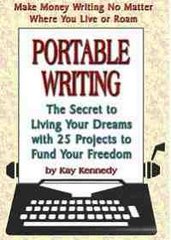
My book, Portable Writing: the Secret to Living Your Dreams with 25 Projects to Fund Your Freedom, is on Writer's Weekly best-seller list this week. Check it out at www.writersweekly.com.

Thursday, April 03, 2008

New Writers - An Easy Way to Get Published Right Away

Beginning writers tend to stress out over all the different things they’ve been taught about writing for publication. How do I even begin to write a query letter? Who do I send it to? Do I even need one? How can I sell my article idea in a query letter when I haven’t written it yet? And what about clips? What in heaven’s name are they? I don’t have any, so what do I do? By this point, most beginners are tearing their hair out—and for good reason.

There is one way you can begin earning money as a published writer right away and you won’t need to write a query letter to do it. Lots of magazines need fillers—short articles, jokes, quizzes, etc,—and greeting card companies need short verses and clever sayings to fill their cards and warm consumers’ hearts. You can get paid to write them, plus you’ll have clips to send out in the future to other magazines as evidence of having been published.

Which magazines need fillers? Well, Reader’s Digest is a leading publication that pays from $100 to $300 for funny true stories. They’re used in "Life in these United States," "All in a Day’s Work" and "Humor in Uniform." They also use jokes, quotes, and other material in "Laughter, the Best Medicine," "Quotable Quotes," and elsewhere in the magazine. And some of these fillers don’t even have to be original. You can send funny items from other published sources.

Go to
www.rd.com/joke to submit original material, and check the magazine for how to send items clipped from other sources. You might find a really funny short piece in your local newspaper that would be suitable for Reader’s Digest. And flip through other popular magazines to see what types of fillers they use, and then submit your own.

By the way, this opportunity isn’t open only to beginning writers. Experienced writers can, and do, regularly earn easy, extra income by writing fillers.
RACING MOTORHOMES? OH YEAH!

During the writer’s strike we discovered some new favorite shows, and one of them is a BBC (British) auto show called “Top Gear.” Now I’m not even a car fan—as long as it runs and doesn’t look too gross, it’s okay with me—but this show is hilarious. On every show, the three men who are regulars find every imaginative way possible to race or have a contest between a variety of vehicles, often built or modified by them.

They’ve taken ordinary cars and extended them to four or five times longer, then raced to reach an award show in downtown London on time, with a celebrity in tow, never mind that some of the extended vehicles couldn’t maneuver the street turns. They’ve taken ordinary used cars (not 4-wheel drive) and raced them across the interior of Africa. Funny? You bet, as they discarded everything that weighted their car down, and eventually stopped to break out the windows, then fought off flies, mosquitoes, and dust as they tried to be first to reach the border over non-existent roads.

They also competed in a race from London to Heathrow Airport. One took a fast boat down the river, one rode a bicycle through traffic, one took public transportation, and one drove a car. Guess which one came in last. The race ended at the airport with the three regulars bemoaning the fact that they were on an auto show that promoted driving, but the car arrived 15 minutes after all the others. The bicycle came in first.

Recently the regulars decided to race several motorhomes around an oval track. Who else would think of anything so ridiculous? There was everything from Class A, to Class C, to one Toyota Class B van with a raised soft top to extend head room. Rules were that the rigs couldn’t touch each other during the race.

Most of the drivers discarded the extra weight the afternoon before the race, but one of the regulars spent his time cooking a gourmet meal in his galley instead, so when the race started, dishes flew out of the cabinets, creating noisy havoc and a dangerous diversion as he tried to concentrate on racing. The other motorhomes didn’t fare much better. Another of the regulars ended the race with only his truck frame and and front end with driver’s seat intact. Everything else was littered along the track, where it had fallen off as his coach bumped into others in his eagerness to win.

Bumping wasn’t necessarily intentional. The big rigs leaned and lurched into each other in the turns, often knocking off and shredding the walls of the units. One made a turn with the left wheels riding up on a curb. The Class-B Toyota plowed between the other motorhomes, sometimes getting frighteningly squeezed and finally losing its top somewhere along the race route. The sight of these behemoths racing and rattling around the track had us in hysterics.


So if you enjoy seeing the newest cars tested (they do try out the newest, latest, most expensive, as well as regular cars like most of us drive), and love a good laugh, you might want to catch this show. Check your guide for day and time. See the motorhome race, click here: http://www.youtube.com/watch?v=gourYCpaJLU&eurl=http://rvvideos.blogspot.com/2008_04_01_archive.html.